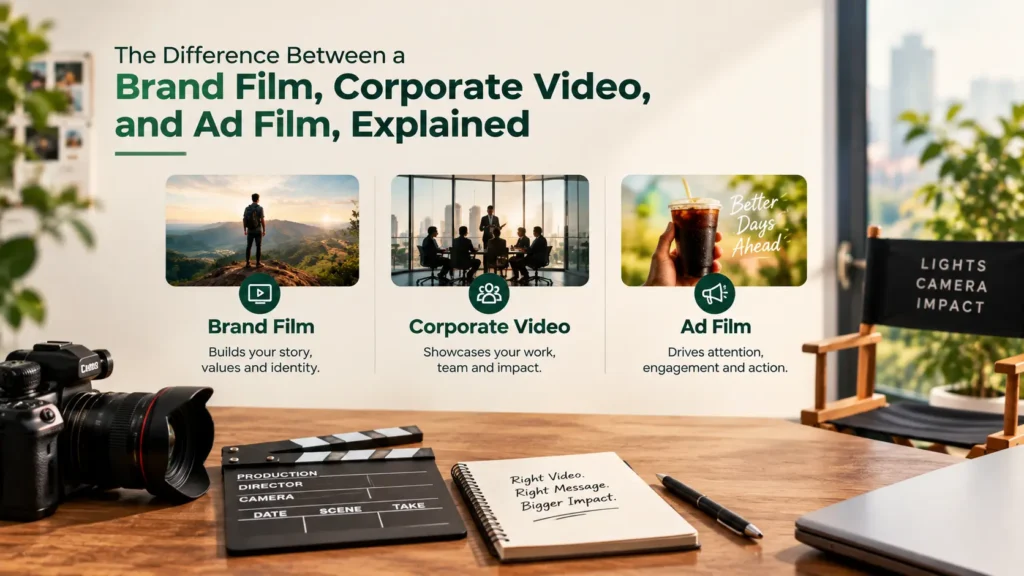
Ask five people in a meeting what kind of video they want, and you will often get three different answers that all sound like the same thing. Someone says “brand film,” someone else says “corporate video,” and someone else says “ad film,” and the brief that comes out of that conversation rarely matches what actually gets delivered.
These three formats solve different problems, have different lengths, different tones, and different places they are meant to live. Knowing which one you actually need, before you brief a production team, saves budget, saves revisions, and gets you a video that does the job it was meant to do.
Why This Confusion Happens So Often
Most businesses do not make video content often enough to have a shared vocabulary for it. Marketing teams, founders, and agencies all use these terms slightly differently, and production companies are not always consistent about it either. The result is a brief that says “corporate video” when what the business actually wants is a brand film, or a request for an “ad film” when a short form content package would serve the goal better.
The fastest way to avoid this is to understand what each format is actually built to do.
What Is a Brand Film
A brand film tells the story of who a company is, what it stands for, and why it matters, without making a direct sales pitch. It is built around identity and emotion rather than a specific product feature or a call to action.
Typical length: two to five minutes, sometimes longer for flagship pieces Typical tone: cinematic, narrative driven, emotionally led Where it lives: homepage, about page, investor decks, major campaign launches, award submissions What it is built to do: build long term brand equity and trust, not drive an immediate transaction
A brand film works well when a company has a genuine story worth telling, founders with a compelling reason for starting the business, a mission that resonates, or a moment in the company’s history worth highlighting. It is the wrong choice when the actual goal is to explain a product feature or push a short term promotion.
What Is a Corporate Video
A corporate video explains what a company does, how it operates, or what it offers, in a clear and functional way. It is less about emotion and more about information, built to answer practical questions a specific audience has.
Typical length: one to three minutes, though internal or training videos can run longer Typical tone: informative, professional, straightforward Where it lives: sales decks, investor presentations, internal training, trade show booths, careers pages What it is built to do: communicate information clearly to a specific audience, often internal, investor, or B2B
Corporate video is the right choice for company overviews, leadership messages, process explainers, onboarding content, or anything where the primary job is clarity rather than emotional storytelling.
What Is an Ad Film
An ad film, often called a commercial, is built around a specific message and a specific action. It is short, direct, and designed to be seen repeatedly across paid media, television, or social platforms.
Typical length: fifteen to sixty seconds, sometimes extended for digital cutdowns Typical tone: punchy, message led. Built for repetition Where it lives: television, paid social, YouTube pre-roll, digital display campaigns What it is built to do: drive a specific response, a purchase, a sign-up, awareness of a launch or promotion, within a defined campaign window
An ad film works when there is a clear offer, product, or moment to promote, and when the content needs to perform within a tight media buying window rather than live indefinitely on a website.
The Core Differences at a Glance
| Brand Film | Corporate Video | Ad Film | |
|---|---|---|---|
| Goal | Build identity and trust | Inform a specific audience | Drive a specific action |
| Length | 2 to 5 minutes | 1 to 3 minutes | 15 to 60 seconds |
| Tone | Emotional, narrative | Clear, professional | Punchy, direct |
| Shelf life | Long term, evergreen | Long term, updated periodically | Tied to a campaign window |
| Primary home | Website, campaigns | Sales decks, internal use | Paid media, television |
How to Choose the Right Format for Your Goal
Start with the actual business goal, not the format name.
-
- If the goal is to build trust and tell a story that will live on your site for years, you want a brand film.
-
- If the goal is to clearly explain what your company does to investors, new hires, or B2B prospects, you want a corporate video.
-
- If the goal is to drive a specific action within a campaign window, a purchase, a sign-up, awareness of a launch, you want an ad film.
Many businesses need all three at different points, and the smartest approach is often planning them together, using one production shoot to capture footage that can support a brand film, a corporate overview, and a set of ad cutdowns, rather than treating each as a separate project from scratch.
Common Mistakes Businesses Make Choosing Between Them
-
- Briefing a brand film when the real need is an ad film with a clear call to action, which leads to a beautiful video that does not drive the result the business actually needed
-
- Using a corporate video’s dry, informational tone for content meant to build emotional connection with customers
-
- Expecting a 60 second ad film to carry the same depth and narrative as a five minute brand film, which leads to a rushed, unclear message
-
- Treating these as one-off purchases instead of planning them as a connected content system, which multiplies both cost and shoot days unnecessarily
FAQ
1. Can one video serve as both a brand film and an ad film?
Not effectively. A brand film is paced for emotional storytelling over several minutes, while an ad film needs to deliver its message in the first few seconds. The better approach is producing both from the same shoot, then editing each separately for its specific purpose.
2. Which format is most important for a new business?
It depends on the stage. A new business often needs a corporate video first, to clearly explain what it does, followed by a brand film once there is a stronger story to tell, and ad films once there is a specific offer or campaign to promote.
3. How much does each format typically cost?
Ad films tend to cost less per asset since they are shorter, though media spend to run them can be significant. Brand films generally require a larger production budget given their length, scope, and narrative complexity. Corporate videos usually sit in between, depending on how much location and crew access is required.
4. Is a corporate video the same as a company profile video?
Largely yes. A company profile video is a common type of corporate video, focused on explaining the business, its operations, and its offerings to an external or internal audience.
5. What term should I use when briefing a production company?
Describe the goal and where the video will live rather than relying on the format name alone, since terminology varies between teams. A good production partner will help translate that goal into the right format.
Final Thoughts
Brand film, corporate video, and ad film are not interchangeable, even though the terms get used loosely in most briefing conversations. Getting clear on the actual goal, build trust, inform an audience, or drive an action, before choosing a format saves both budget and revision cycles, and it is the difference between a video that looks good and one that actually does its job.
If you are not sure which format fits your next project, Bandish Studios can help you figure it out before a single shoot day is booked.