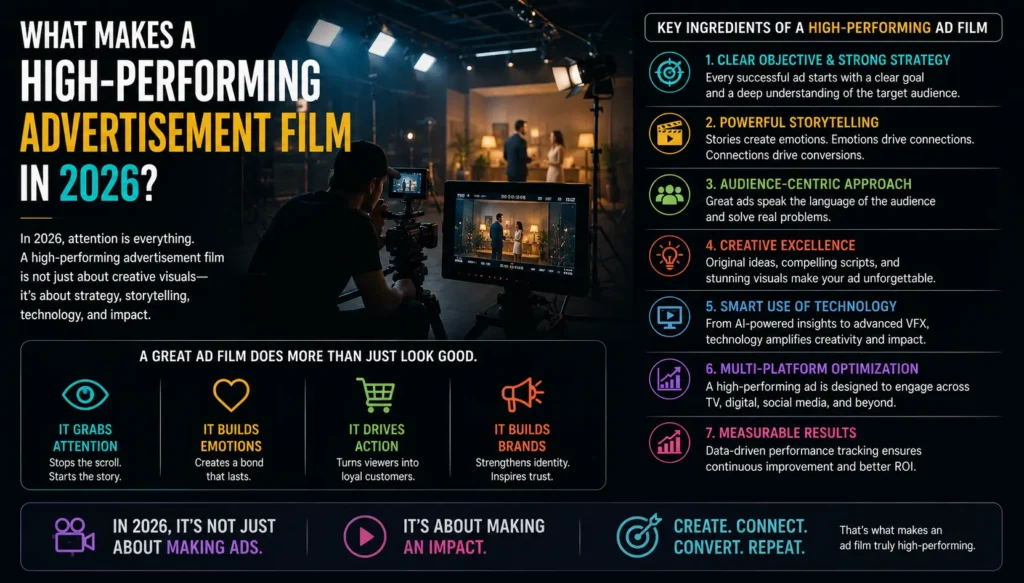
The rules of advertising have changed dramatically over the past decade. Audiences skip ads, install ad blockers, and scroll past promotional content without a second thought. In 2026, the brands that are cutting through this resistance are not doing it with bigger budgets or louder messaging. They are doing it with better advertisement films that are built on storytelling, emotional intelligence, and a deep understanding of how modern audiences actually consume content.
A high-performing advertisement film in 2026 is not just a video that looks good. It is a precisely crafted piece of content that captures attention instantly, holds it through a compelling narrative, and moves the viewer toward a specific feeling or action by the time it ends. At Bandish Studios, we have produced advertisement films for brands across Pune and Maharashtra and the patterns that separate high-performing ads from forgettable ones are consistent across every industry and every budget level. This blog breaks down exactly what those patterns are.
1. It Captures Attention in the First Three Seconds
The most important moment in any advertisement film is the opening frame. On every major platform in 2026, including YouTube, Instagram, and connected TV, viewers have the ability to skip or scroll past your ad within seconds of it beginning. If your opening does not immediately give them a reason to keep watching, the rest of your production investment is irrelevant.
What a Strong Opening Looks Like
High-performing advertisement films open with something unexpected, emotionally resonant, or visually arresting. A question that speaks directly to the viewer’s situation. A scene that creates immediate tension or curiosity. A bold visual that is impossible to ignore on a scrolling feed. The opening of a high-performing advertisement film earns the next ten seconds. Those ten seconds earn the rest.
Brands that open with their logo, a sweeping brand statement, or a slow establishing shot are consistently losing viewer attention before their core message has been communicated. In 2026, the hook comes first. Everything else follows.
2. It Is Built Around a Single Clear Message
One of the most common mistakes in advertisement film production is trying to communicate too much in a single video. A 60-second ad that attempts to cover three product benefits, two brand values, and a promotional offer will almost always underperform a 60-second ad that drives home a single idea with depth and precision.
The Single Message Principle
Before any advertisement film goes into production, the creative brief must answer one question clearly: what is the single thing we want the viewer to feel, believe, or do after watching this? Every subsequent decision in scripting, casting, direction, and editing should serve that one answer.
This principle is not a creative limitation. It is the discipline that makes advertising work. Audiences retain one strong idea far more reliably than three average ones. A focused advertisement film that lands its core message creates the brand recall and emotional association that drives purchasing decisions over time.
3. It Uses Storytelling Rather Than Selling
The most effective advertisement films in 2026 do not feel like advertisements. They feel like stories that happen to involve a brand. This distinction is not accidental. It is the result of intentional creative strategy that prioritises narrative structure over promotional messaging.
Why Story Outperforms Promotion in 2026
Human brains are wired for narrative. When we encounter a story with a relatable character, a problem, and a resolution, we engage emotionally and our psychological resistance to persuasion drops. This is exactly the state in which a brand message lands most effectively.
Contrast this with a traditional promotional ad that lists product features or announces a sale. The moment an audience recognises they are being sold to, their defences go up and the effectiveness of the message drops significantly. The brands winning with cinematic brand storytelling understand this and build every advertisement film around a human narrative that earns the viewer’s engagement before the brand message is delivered.
Story Structures That Work in Advertisement Films
The most reliable narrative structure for a short advertisement film is the problem-solution arc. A relatable character faces a real challenge that the target audience recognises. The brand’s product or service enters the story as the enabler of a meaningful resolution. The viewer leaves with an emotional association between the brand and a positive outcome.
Other effective structures include the transformation story, the aspiration narrative, and the behind-the-scenes authenticity format. Each works because it centres the viewer’s experience and needs rather than the brand’s desire to promote itself.
4. It Is Produced with Cinematic Quality
Visual quality communicates brand value before a single word of copy is processed. When a viewer encounters an advertisement film with professional cinematography, intentional lighting, smooth camera movement, and polished post-production, they form an immediate subconscious judgement about the brand being represented.
What Cinematic Quality Means in Practice
Cinematic quality does not require the largest possible budget. It requires the right creative decisions at every stage of production. A well-lit interview filmed with a single professional camera and a skilled director will consistently outperform a technically complex production that lacks creative coherence.
The specific elements that elevate an advertisement film to cinematic quality include thoughtful location selection, professional lighting that serves the story’s emotional tone, camera movement that feels intentional rather than arbitrary, colour grading that reinforces the brand’s visual identity, and sound design that supports the narrative without overwhelming it.
At Bandish Studios, our advertisement film production process applies cinematic thinking at every stage, from pre-production planning through to final colour grade and audio mix, because we know that production quality is inseparable from brand perception.
5. It Is Optimised for the Platform It Will Run On
A high-performing advertisement film in 2026 is not a single universal asset. It is a piece of content designed specifically for the platform, audience, and context in which it will be seen. An ad that is optimised for YouTube pre-roll will perform very differently than one designed for Instagram Reels or a television broadcast slot, even if the core creative concept is the same.
Platform-Specific Considerations for Advertisement Films
For YouTube pre-roll, the first five seconds before the skip option appears are the most critical. The ad must deliver enough of the hook within those five seconds to make the viewer choose to keep watching. For Instagram and Facebook, the vertical format, silent autoplay, and caption dependency require a fundamentally different approach to visual composition and information hierarchy.
For connected TV and OTT platforms, longer formats with higher production values perform well because viewers are in a lean-back consumption mode rather than a scrolling one. Each platform requires its own approach to pacing, aspect ratio, caption strategy, and call to action placement.
Brands working on multi-platform advertisement film campaigns should always plan for platform-specific edits during pre-production rather than attempting to reformat a single master cut after the fact. The most effective platform edits are planned before the camera rolls, not after.
6. It Has a Purposeful and Specific Call to Action
A high-performing advertisement film always ends with a clear instruction for the viewer. Not a vague brand statement. Not a tagline without direction. A specific, actionable next step that is directly connected to the campaign’s objective.
What Makes a Call to Action Work in an Advertisement Film
The most effective calls to action in advertisement films are those that feel like a natural extension of the story rather than a sudden pivot to promotion. If the narrative has successfully built emotional engagement and brand desire, the call to action simply tells the viewer where to take that desire next.
For brand awareness campaigns, the call to action might simply be to follow, visit, or remember. For conversion-focused campaigns, it should be a specific action tied to a measurable outcome, such as visiting a landing page, booking a consultation, or using a specific offer code. Either way, the call to action must be present, clear, and placed where the viewer’s engagement is at its highest.
7. It Is Measured, Analysed, and Refined
The final characteristic of a high-performing advertisement film in 2026 is that it exists within a system of continuous improvement. The brands producing the most effective advertising content are not just making great films. They are analysing performance data, identifying what is working at each stage of the viewer journey, and applying those insights to make every subsequent film more effective than the last.
Key Metrics to Track for Advertisement Film Performance
- View-through rate: The percentage of viewers who watch beyond the skip point or scroll-past moment
- Audience retention graph: Where viewers are dropping off within the video and what creative choices might be causing it
- Click-through rate: How effectively the call to action is converting viewer attention into measurable action
- Brand recall lift: Available through platform brand lift studies for larger campaigns, measuring the actual impact on brand awareness
- Conversion rate: For performance campaigns, how efficiently the ad is driving the specific business outcome it was designed for
Each of these metrics tells a specific story about how the creative is performing at a different stage of the viewer’s experience. Understanding what the data is saying and translating that understanding into better creative decisions is what separates brands that improve consistently from those that repeat the same mistakes across every campaign.
Final Thoughts: Great Advertisement Films Are Built, Not Hoped For
A high-performing advertisement film in 2026 does not happen by accident. It is the result of a disciplined creative process that begins with a clear brief, develops through intentional storytelling and cinematic production, and continues through performance analysis and iterative refinement. Every element of the film, from the opening hook to the final call to action, is a deliberate creative decision made in service of a specific outcome for the brand.
The brands in Pune and across Maharashtra that are seeing the strongest results from their video advertising content are those that treat every advertisement film as a strategic investment rather than a production exercise. They know what they want the viewer to feel, they build every creative decision around that goal, and they use performance data to get better with every campaign they run.
At Bandish Studios, we bring this strategic and cinematic approach to every advertisement film we produce. From the initial creative brief through to final delivery and campaign analysis, we help brands across Pune create advertisement films that perform on every platform and deliver measurable results for their business.
Ready to Create an Advertisement Film That Actually Performs?
Talk to the Bandish Studios team about producing a high-performing advertisement film for your brand in Pune. We combine creative storytelling, cinematic production, and platform-specific strategy to help your brand cut through the noise and connect with the audiences that matter most to your business.