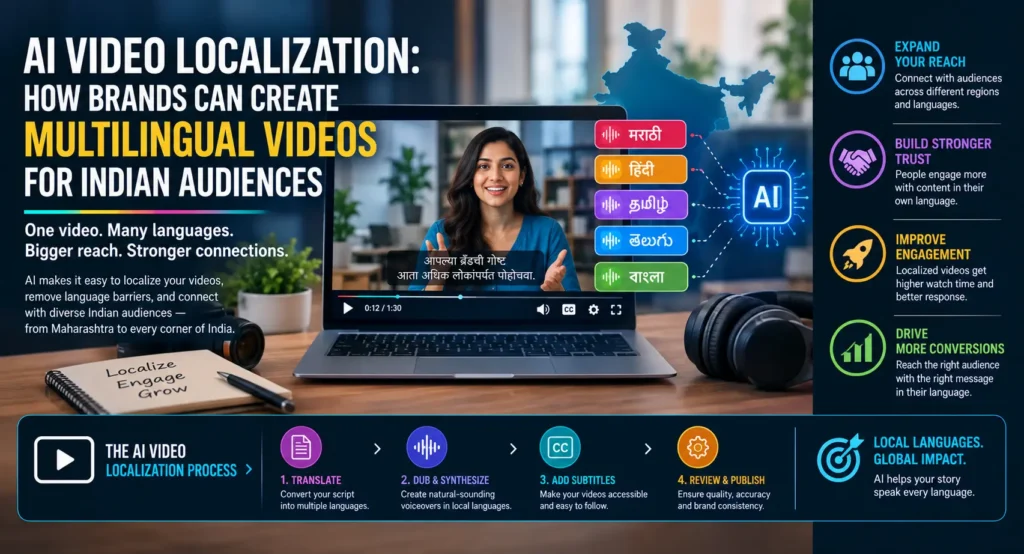
India does not have one audience. It has dozens. A brand that speaks only in English, or only in Hindi, is leaving most of the country’s viewers out of the conversation. That is the problem AI video localization is starting to solve, and it is why more Indian brands are asking how to turn one video into ten, in ten different languages, without ten different production budgets.
This guide covers what AI video localization actually does, where it genuinely helps Indian brands, and where it still needs a human hand to avoid getting culture and context wrong.
Why Video Localization Matters for Indian Audiences
India has 22 officially recognized languages and hundreds of dialects spoken across its states. Add to that the sharp differences in how audiences in Mumbai, Chennai, Lucknow and Guwahati respond to tone, pacing and humor, and “localization” stops being a nice to have. It becomes the difference between a video that converts and one that gets scrolled past.
A few numbers worth keeping in mind:
- Regional language internet users in India significantly outnumber English-first users.
- Vernacular content consistently drives higher watch time and engagement on Indian social platforms than English-only content.
- D2C, fintech, edtech and FMCG brands are already competing for attention in Hindi, Tamil, Telugu, Bengali and Marathi simultaneously.
Producing separate shoots for each language was never realistic for most marketing budgets. AI localization changes that math.
What Is AI Video Localization
AI video localization uses machine learning to adapt an existing video into another language, without reshooting it. Depending on the tool, this can include:
- AI dubbing, replacing the original voice with a translated, AI-generated voice track
- Lip-sync adjustment, so the speaker’s mouth movements roughly match the new language’s audio
- Subtitle and caption generation, translated and time-synced automatically
- Voice cloning, keeping the original speaker’s voice characteristics across languages
- On screen text and graphic translation, for videos with text overlays, captions or product labels
The goal is one master video that gets adapted into many language versions quickly, instead of being rebuilt from scratch for each market.
India’s Linguistic Reality Businesses Need to Plan For
Before choosing tools or vendors, it helps to be specific about what “multilingual” means for your brand.
It is rarely just Hindi and English
Many brands localize into Hindi and stop there, assuming it covers the rest of the country. It does not. A fintech brand targeting Tamil Nadu, Maharashtra, Telangana and West Bengal in Hindi alone will still be speaking past a large share of its audience.
Script and script rendering matter
Devanagari, Tamil, Marathi, Telugu, Bengali and Gurmukhi scripts all render differently on screen. Subtitle formatting that looks clean in English can break, overlap or become unreadable in another script if the tool or template was not built with Indian scripts in mind.
Dialect and register differ within a single language
Hindi spoken in Delhi advertising is not the Hindi spoken in a Bihar market town. Formal, “shuddh” Hindi can sound stiff or alienating in some regions and perfectly appropriate in others. AI tools translate language. They do not automatically choose the right register for your specific audience.
How AI Video Localization Actually Works, Step by Step
- Transcription. The tool transcribes the original video’s audio into text.
- Translation. That transcript is translated into the target language, usually by machine translation with an option for human editing.
- Voice generation or dubbing. An AI voice, either cloned from the original speaker or a stock AI voice, reads the translated script.
- Lip-sync adjustment. Some tools adjust the on screen mouth movements to roughly match the new audio.
- Subtitle and text overlay translation. Any on screen text, lower thirds or captions get translated and repositioned.
- Human review. This step is optional in most tools, and it is the one brands most often skip when they should not.
Where AI Dubbing Works Well for Indian Content
- Internal and training videos, where clarity matters more than cinematic tone
- Product explainers and how to content, where the message is functional and literal translation works fine
- High-volume social clips, where speed and reach matter more than perfect nuance
- Repurposing existing brand films into additional languages for regions where a full reshoot was never in the budget
Where Human Oversight Still Matters
Cultural nuance beyond translation
A phrase that lands as warm and relatable in English can sound flat, overly formal or even slightly off in a literal translation. Idioms, humor and emotional beats often need a copywriter familiar with the target language to adapt rather than translate.
Festivals, references and visuals
A video shot with Diwali imagery does not automatically make sense dubbed for a Southern audience during a different festival season. Visual and cultural references sometimes need to change, not just the voice track, and AI tools do not catch this on their own.
Brand voice consistency
An AI-cloned voice can sound technically correct and still miss the warmth, humor or authority that defines how your brand actually talks to people. This is where a human review pass, ideally by someone who is a native speaker of the target language, catches what the tool misses.
Regional dialect and tone choices
Choosing between a formal and a conversational register in Marathi, Kannada or Bengali is a judgment call, not a translation setting. This is usually the single biggest quality gap between AI only localization and a workflow with a human editor involved.
A Practical Workflow for Indian Brands
- Identify your top three to five priority languages based on where your actual audience and customers are. Example Mumbai and Maharashtra – Marathi, not assumptions about what “covers most of India.”
- Produce one strong master video with clean audio, minimal on screen text, and pacing that leaves room for translated speech, since some languages need more time to say the same thing.
- Use AI tools for the first-pass translation, dubbing and subtitle generation.
- Route every localized version through a native speaking reviewer before publishing, even if it adds a day to the timeline.
- Track engagement by language separately. Watch time and completion rates often vary significantly between language versions, and that data should shape which languages get investment next.
Common Mistakes Brands Make with AI Localization
- Treating Hindi as a stand in for “all of India”
- Skipping the human review step to save time, then publishing content with awkward or unintentionally funny phrasing
- Using a script written for English pacing, without editing time or space for languages that need more words to say the same thing
- Ignoring subtitle formatting differences across scripts, resulting in overlapping or cut off text
- Localizing the voice track but not the on screen graphics, leaving English text in an otherwise Hindi or Tamil video
FAQ
Can AI fully replace human translators for video localization in India?
Not for brand critical content. AI handles the technical work of translation, dubbing and subtitling quickly, but nuance, humor, regional dialect and cultural references still need a native speaking human reviewer to avoid content that reads as tone deaf or awkward.
How many languages should an Indian brand localize into first?
Start with three to five languages based on where your actual customers are. Expanding based on real engagement data is safer than guessing which regions matter most.
Does AI dubbing work well for Indian regional languages?
Quality varies by language. Widely spoken languages like Hindi, Tamil and Telugu tend to have more mature AI voice and dubbing support than less commonly digitized languages, so it is worth testing a short sample before committing to a full campaign.
What is the biggest localization mistake Indian brands make?
Assuming Hindi alone covers the country. India’s linguistic diversity means a genuinely multilingual strategy, not a single additional language, is usually what actually moves engagement.
Is AI video localization affordable for smaller brands?
Yes, for high volume or lower stakes content. For flagship brand films or campaigns, budgeting for a human review pass on top of the AI tooling is worth the cost, since it protects against errors that can undercut trust in a new market.
Final Thoughts
AI video localization has made it realistic for Indian brands to speak to the country’s audiences in their own languages, without the cost of reshooting for every region. The technology handles the heavy lifting of translation, dubbing and subtitling well. What it still cannot do on its own is understand which register, tone or reference will actually land with a specific regional audience, and that is where a human production partner earns its place in the workflow.
If you are planning a multilingual video campaign and want a workflow that pairs AI speed with the cultural judgment that keeps your brand voice intact, Bandish Studios can help you build it.