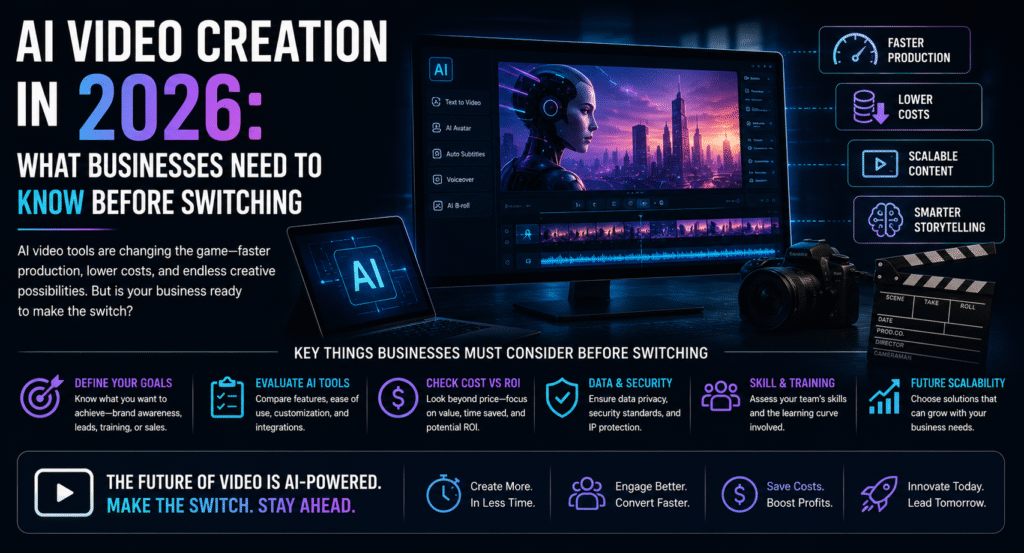
Every marketing team has had the same conversation in the last twelve months: should we just switch to AI video tools?
It’s not a bad question. AI video generators have gotten dramatically better, budgets are tighter than ever, and the pressure to publish more content, faster, isn’t going away. But “switching to AI” is not a single decision it’s a bundle of smaller ones about quality, brand risk, workflow, and where AI actually helps versus where it quietly costs you more than it saves.
This guide breaks down what’s genuinely changed in AI video creation in 2026, what businesses tend to get wrong when they switch too fast, and how to make the call for your own brand.
Why This Question Is on Every Marketer’s Desk in 2026
A few things converged at once this year:
-
- Model quality jumped again. Text-to-video and AI avatar tools produce noticeably fewer visual glitches than they did even 18 months ago.
-
- Budgets are under scrutiny. Marketing teams are being asked to do more with flat or shrinking budgets, and video is expensive to produce at volume.
-
- Content velocity matters more than ever. Social platforms reward consistent posting, and one hero video a quarter no longer cuts it.
Those are all legitimate reasons to look at AI video seriously. They are not, on their own, reasons to switch your entire video strategy over to it.
What’s Actually Changed in AI Video Tools This Year
Before deciding anything, it helps to separate the real progress from the hype.
Genuinely better in 2026:
-
- Lip-sync and AI avatar realism for talking-head and explainer-style content
-
- Text-to-video consistency across shorter clips (5-15 seconds)
-
- AI voice cloning and multilingual dubbing, which is a real win for global brands
-
- Auto-editing tools that can repurpose one long video into dozens of social cuts
Still limited, whatever the marketing pages claim:
-
- Long-form narrative consistency (characters, sets, and lighting drifting across a full video)
-
- Authentic human emotion and nuanced performance
-
- Real locations, real products, real customers on camera
-
- Brand-specific visual identity that doesn’t look like every other AI-generated video in your feed
This is the part most “switch to AI” conversations skip. The tools are excellent at specific jobs. They are not yet a wholesale replacement for a video production process built around your brand and your audience.
The Real Cost of Switching (Beyond the Subscription Fee)
The pitch for AI tools is almost always about cost and speed. That’s true for the first video. It gets more complicated after that.
- Learning curve time. Someone on your team has to become good at prompting, editing, and QA-ing AI output. That’s real hours, even if the tool itself is cheap.
- Brand consistency risk. Off-the-shelf AI avatars and templates are shared across thousands of other businesses. If your competitor uses the same tool, your “unique” video can look identical to theirs.
- The revision problem. AI video is fast for a first draft and often surprisingly slow to fine-tune when a stakeholder wants a specific change you’re negotiating with a prompt, not a director.
- Where the content actually lives. A polished 30-second AI clip for social is a very different asset than a brand film, a product launch video, or a testimonial that needs to build trust. Using the wrong tool for the wrong job is where most of the “AI video looks cheap” complaints come from.
None of this means AI video is a bad investment. It means it’s a tool, not a strategy on its own and treating it as a full replacement for production is usually where businesses get burned.
Where AI Video Genuinely Wins for Businesses
To be fair to the tools, there are use cases where AI video is the obviously right call:
-
- High-volume social content daily or weekly short-form clips where speed matters more than cinematic polish
-
- Internal and training content onboarding videos, process explainers, and updates where production value matters less than clarity
-
- Rapid A/B testing of ad creative generating variations quickly to find what resonates before investing in a bigger production
-
- Multilingual localization dubbing and subtitling existing video assets for new markets without reshoots
Where a Production Team Still Wins
-
- Brand films, launch videos, and anything meant to build trust the moments where audiences can tell the difference between generated and genuine
-
- Advertisements meant to stand out because everyone now has access to the same AI tools, a distinctive, human-directed film is becoming a differentiator again, not a luxury
-
- Anything featuring real customers, real products, or real locations testimonials, facility tours, hospitality and real estate content
-
- Storytelling that needs emotional nuance the kind of pacing, performance, and cinematography that current AI models still can’t fully replicate
Questions to Ask Before You Switch
Before moving budget away from production toward AI tools, run through these:
- What is this video actually for? Awareness, conversion, trust-building, and internal training all have different quality bars.
- Where will it live? A hero video on your homepage has different requirements than a 15 second Reel.
- What happens if it looks like everyone else’s AI video? If your category is already flooded with AI-generated content, sameness becomes a real risk.
- Who owns quality control? Someone needs to catch the uncanny-valley moments, the mispronunciations, and the off-brand visuals before they go live.
- Is this actually about cost, or about speed? Those call for different solutions sometimes the answer is a hybrid workflow, not a full switch.
The Hybrid Approach Most Businesses Land On
In practice, the businesses getting the best results in 2026 aren’t choosing AI video or production they’re combining both. A typical hybrid workflow looks like:
-
- Professionally produced hero content (brand films, ads, launch videos) for the moments that build trust
-
- AI-assisted repurposing of that same footage into dozens of social-ready clips
-
- AI tools for internal, high-volume, or rapid-testing content where speed beats polish
-
- A production partner who understands both sides well enough to tell you which is which
That’s the model Bandish Studios works with using AI to scale output where it makes sense, while keeping cinematic, human-directed production for the content that represents your brand at its highest stakes.
FAQ
Is AI video creation good enough to replace a production company in 2026?
For some formats short social clips, internal training, rapid ad testing yes. For brand films, advertisements, and anything meant to build trust with an audience, professional production still outperforms AI on nuance, consistency, and differentiation.
How much does switching to AI video tools actually save?
Subscription costs are low compared to production budgets, but factor in prompting and editing time, brand consistency revisions, and the risk of content that looks generic. For high volume, lower stakes content, savings are real. For flagship brand content, the “savings” often disappear once you account for the time spent fixing AI output.
Can AI video and traditional production work together?
Yes, and for most businesses this is the practical answer. Use production for hero content and brand defining videos, and AI tools to scale that content into more formats, languages, and platforms.
What should businesses look for before choosing an AI video tool?
Brand customization options, output resolution and consistency, ease of revisions, and whether the tool’s outputs are becoming visually generic across your industry.
Is now a good time for businesses to invest in AI video?
Yes as a complement to a video strategy, not a replacement for it. The businesses winning right now are the ones using AI to scale reach while protecting the quality of their core brand content.
Final Thoughts
AI video creation in 2026 is genuinely useful but “switching” is the wrong frame. The businesses getting real results are pairing AI’s speed with the judgment, storytelling, and craft that still only comes from a production team that understands their brand.
If you’re weighing where AI fits into your video strategy and where it doesn’t, Bandish Studios can help you build a workflow that uses both without gambling your brand’s biggest moments on a tool that doesn’t know your audience.