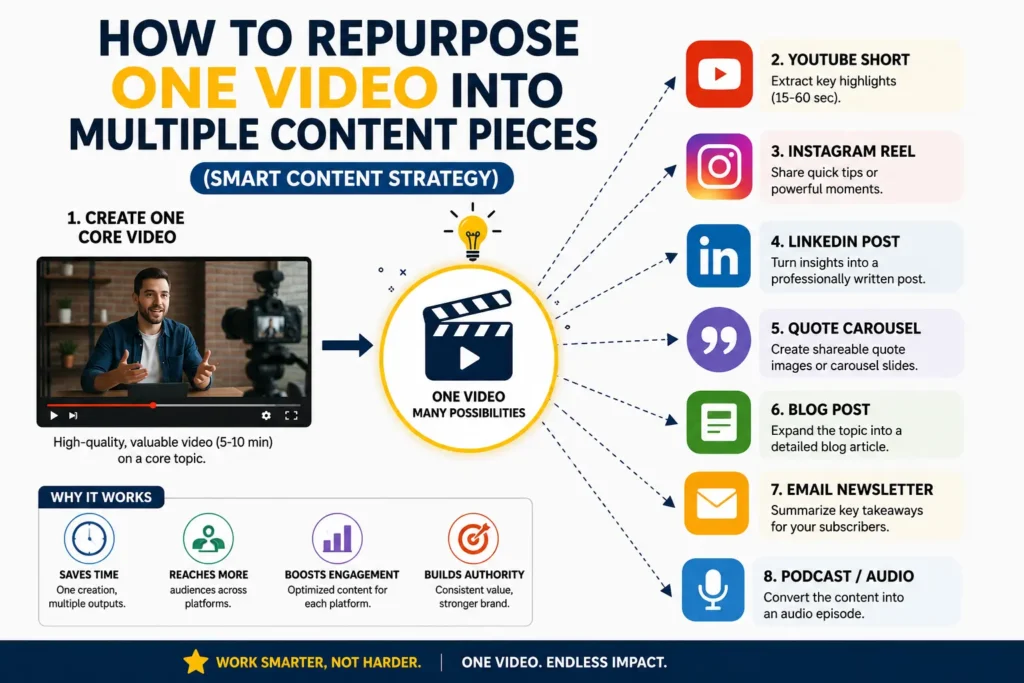
Most brands invest significant time, money, and effort into producing a single video and then publish it once before moving on to the next project. This is one of the most common and costly mistakes in modern content marketing. A well-produced video is not a one-time asset. It is a content goldmine that can be repurposed into dozens of individual pieces across multiple platforms, formats, and audiences.
Repurposing video content is the smartest way to stretch your production budget, maintain a consistent publishing schedule, and reach audiences who prefer different types of content. At Bandish Studios, we work with brands across Pune and Maharashtra to build video content strategies that extract maximum value from every shoot. Here is exactly how to repurpose one video into multiple content pieces and build a smarter, more sustainable content strategy.
Why Video Repurposing Is a Smart Content Strategy
The average brand spends anywhere from INR 30,000 to several lakhs producing a professional video. When that video lives only on one platform, the return on that investment is limited. Repurposing multiplies the ROI of every rupee spent on production by distributing the same core content across different channels and formats.
Key Benefits of Repurposing Video Content
-
- Cost efficiency: One production budget generates weeks of content across multiple platforms
-
- Wider reach: Different audiences consume content differently some prefer short clips, others prefer written posts or podcasts
-
- Consistent publishing: Repurposed content fills your content calendar without requiring a new shoot every week
-
- Better SEO: The same message distributed across blogs, YouTube, and social media builds stronger search visibility over time
-
- Stronger brand recall: Seeing the same core message in multiple formats reinforces your brand identity across touchpoints
Start with a Hero Video: The Foundation of Your Content Strategy
The repurposing approach works best when you begin with what content marketers call a “hero video.” This is your main, fully produced video asset a brand film, a product explainer, a client testimonial, an event highlight reel, or a long-form educational video.
What Makes a Good Hero Video for Repurposing
The best hero videos for repurposing are those that contain multiple distinct moments, clear talking points, strong visuals, and quotable statements. A 3 to 5 minute brand film or a 10 to 15 minute interview-style video gives you the most raw material to work with when breaking content down into smaller pieces.
When planning your next shoot at Bandish Studios, we always recommend thinking about repurposing before the camera rolls. Planning for multiple outputs during pre-production saves significant time and budget in post-production.
10 Ways to Repurpose One Video into Multiple Content Pieces
Here is a practical breakdown of exactly how to extract maximum content from a single video production.
1. Cut Short Clips for Instagram Reels and YouTube Shorts
Extract the most impactful 15 to 60 second moments from your hero video and reformat them as vertical (9:16) short-form clips. Each clip should work as a standalone piece of content with its own hook, message, and call to action. A single 5 minute video can easily yield 5 to 8 individual Reels or Shorts with unique angles.
2. Create a Teaser or Trailer Clip
Edit a 20 to 30 second highlight version of your full video designed to drive traffic to the longer cut. Use this as a paid ad, a Stories post, or a LinkedIn introduction post that links to the full video on YouTube. Teaser clips are especially effective for product launches and event coverage.
3. Extract Audio for a Podcast or Audio Content
If your hero video includes interviews, panel discussions, expert commentary, or storytelling, the audio track can be uploaded directly as a podcast episode or audio snippet. This is particularly effective for B2B brands and thought leadership content on platforms like Spotify or Apple Podcasts.
4. Pull Quote Graphics for Social Media
Transcribe your video and identify 5 to 10 strong, standalone quotes or key statements. Design each as a branded static graphic or animated quote card for Instagram, LinkedIn, and Facebook. These perform extremely well as engagement-driving posts and require minimal design time.
5. Write a Long-Form Blog Post
Use the transcript of your video as the foundation for a full SEO-optimised blog post. Expand on the key points, add supporting data and examples, and structure it with proper heading tags. This creates a searchable written version of your video content that drives organic traffic to your website long after the original video was published.
6. Create an Infographic or Carousel Post
Distil the key steps, statistics, or insights from your video into a visual infographic or a multi-slide carousel post for Instagram and LinkedIn. Carousel posts consistently deliver among the highest engagement rates on LinkedIn and Instagram, making this one of the most valuable repurposing formats available.
7. Build an Email Newsletter
Summarise the core message of your video in a concise email newsletter for your subscriber list. Include a thumbnail image that links back to the full video. This drives views from your existing audience while keeping your email list engaged with fresh content without writing from scratch.
8. Design a Pinterest or Google Business Post
Still frames and graphic elements from your video can be repurposed as Pinterest pins or Google Business profile updates. For local brands in Pune looking to improve their local SEO and visibility, regular Google Business posts with strong visuals from your video shoots can directly support search rankings.
9. Use Clips for Paid Advertising
Short, high-impact clips from your hero video can be repurposed as Meta ads, YouTube pre-roll ads, or LinkedIn sponsored content. Using existing footage in ads significantly reduces your cost per creative and keeps your paid media aligned with your organic content.
10. Add to Your Website as Evergreen Content
Embed your full hero video on a relevant service or landing page on your website. Video on landing pages is proven to increase time-on-page and conversion rates. Short clips can also be embedded in product pages, team pages, or case study sections to add depth and credibility.
Repurposing Roadmap – One Video, Multiple Platforms
Here is a quick reference table showing exactly how one hero video can be distributed across different platforms and formats.
| Content Piece | Platform | Format |
|---|---|---|
| Full hero video | YouTube, Website | 16:9 horizontal, long-form |
| Short highlight clips (5 to 8) | Instagram Reels, YouTube Shorts | 9:16 vertical, 15 to 60 seconds |
| Teaser or trailer | Instagram Stories, LinkedIn, Meta Ads | 9:16 or 1:1, 20 to 30 seconds |
| Audio episode | Spotify, Apple Podcasts | MP3 audio |
| Quote graphics (5 to 10) | Instagram, LinkedIn, Facebook | 1:1 static or animated graphic |
| Blog post | Website, Google Search | Long-form written article |
| Carousel post | Instagram, LinkedIn | Multi-slide PDF or image set |
| Email newsletter | Email subscribers | HTML email with video thumbnail |
| Paid ad creatives | Meta, YouTube, LinkedIn Ads | Various short-form cuts |
| Website embed | Landing pages, service pages | Embedded player |
Bandish Studios Tip: During every video shoot, capture extra b-roll footage, wide shots, and candid team moments specifically for repurposing. Having this additional footage gives your editor far more flexibility when cutting content for different formats and platforms.
How to Plan a Repurposing Strategy Before You Shoot
The most efficient repurposing happens when it is planned before production begins, not after. Here is how to approach your next shoot with repurposing in mind.
Define Your Outputs Before Pre-Production
Before your shoot day, list every format you intend to create from the footage. Brief your videographer and director on the specific moments, angles, and talking points needed for each output. When the team knows a clip needs to work as a standalone Reel, they will frame it accordingly.
Capture in the Highest Quality Possible
Always shoot in the highest resolution available. 4K footage can be cropped and reformatted for vertical video without losing quality. This gives your post-production team maximum flexibility when cutting for different aspect ratios and platforms.
Record Clean Audio Separately
If your video involves interviews or voiceover, record audio on a dedicated microphone simultaneously. Clean audio is essential for podcast repurposing and makes captioning far more accurate, saving time in post-production.
Final Thoughts: Work Smarter with Every Video You Produce
Repurposing video content is not about cutting corners. It is about working smarter with the production investment you have already made. Every video your brand produces carries the potential to reach audiences across multiple platforms, in multiple formats, for weeks or months after the original publish date.
Brands in Pune and across Maharashtra that adopt a repurposing mindset consistently publish more content, spend less per piece of content, and build stronger brand presence across every channel their audience uses.
At Bandish Studios, we build repurposing strategies into every production we deliver. Whether you are shooting a brand film, a product video, a testimonial series, or an event highlight reel, we help you plan for maximum content output from day one.