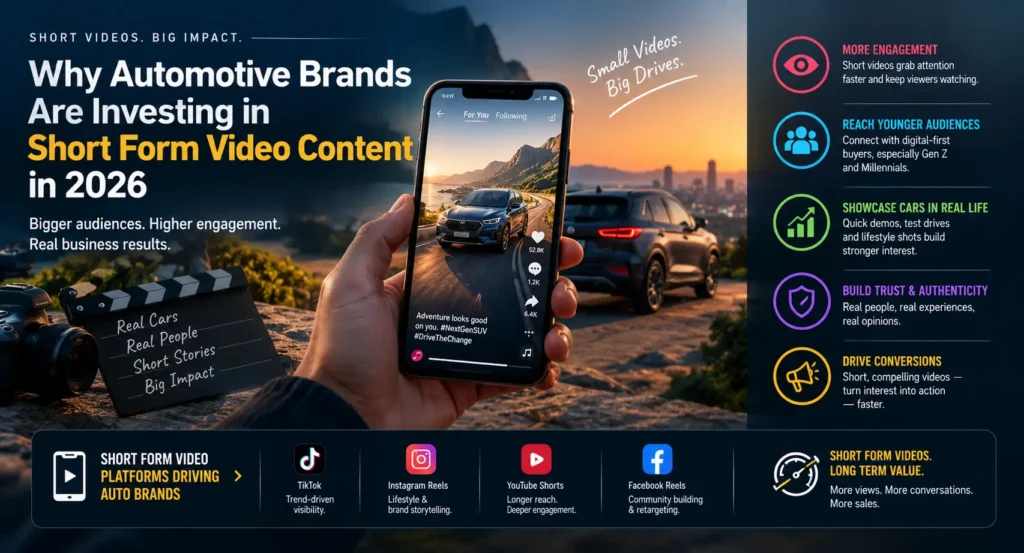
A car buyer today watches dozens of short videos before they ever set foot on a dealership floor. Walkarounds, comparison clips, owner reactions, quick feature explainers, all of it consumed in fifteen to sixty second bursts on Instagram, YouTube. That shift in how people research a purchase this significant is why automotive brands, from individual dealerships to full OEMs, are pulling budget out of longer format content and putting it into short form video.
This is not a passing trend chasing algorithm changes. It reflects a real change in how automotive buyers make decisions, and brands that treat short form video as a core channel rather than a side experiment are seeing it show up in showroom traffic and sales conversations.
Why Short Form Video Fits the Automotive Buying Journey So Well
Buying a vehicle is a long consideration cycle with many small decision points along the way. Short form video maps onto that journey better than almost any other format.
- Buyers research in short, frequent sessions, often during commutes or downtime, rather than one long sitting
- Comparing trims, features or competing models is easier through quick, focused clips than a single long review
- Short videos are easy to share within a household or friend group when a buying decision involves more than one person
- Platforms actively push short form content into feeds of people who have shown any car-buying intent, extending organic reach further than long-form content typically gets
The result is that a single well-made short clip can influence a buyer at multiple points in their journey, not just once.
What Changed for Automotive Brands by 2026
A few shifts pushed short form from “nice to have” to a budget priority this year.
- Platform algorithms now favor vertical video heavily, which means brands publishing only landscape content are losing organic reach by default
- In car and dealership content creators matured, giving brands more comfort putting real people, not just polished ads, in front of the camera
- Attribution got better, so marketing teams can now tie specific short form content to test drive bookings and lead form fills, not just views
- Production costs came down, since a single shoot day can now produce a month’s worth of short clips instead of one expensive commercial
Where Short Form Video Is Actually Working for Automotive Brands
Walkaround and feature spotlight videos
Fast, focused videos covering one feature, one trim difference, or one walkaround angle. These consistently outperform longer full review content in watch time and shares, because they answer one specific question a buyer already has.
Owner and customer story clips
Short interviews or reaction clips from real owners build trust in a way branded advertising cannot. For dealer groups especially, these clips often outperform paid ads on a cost-per-lead basis.
Behind the scenes and dealership culture content
Service bay footage, delivery day moments, and team culture clips humanize a brand and consistently perform well for engagement, even when they are not directly sales-focused.
Comparison and myth-busting content
Quick clips addressing a specific buyer question, fuel economy myths, maintenance cost comparisons, financing misconceptions, tend to get saved and shared more than standard promotional content, because they solve a real research problem.
Launch and reveal teasers
Short, high-energy clips building anticipation ahead of a model launch or dealership event, often cut down from a single larger production shoot into a week’s worth of teaser content.
The Mistake Most Automotive Brands Make With Short Form Video
The most common failure is not lack of effort, it is treating short form video as a smaller version of a TV commercial instead of its own format.
- Overly polished, ad-style content gets scrolled past faster than something that feels native to the platform
- Reusing a 30 second TV spot as a vertical crop, instead of shooting content built for vertical framing from the start
- Publishing inconsistently, a few clips around a launch and then nothing for months, instead of a steady content rhythm
- Skipping captions and text overlays, which matters heavily since a large share of short form video is watched with sound off
- Chasing trends that do not fit the brand voice, which can read as try hard rather than authentic
Building a Short Form Video Strategy That Actually Works
- Shoot in batches. One well planned shoot day can produce weeks of content across walkarounds, features, and owner stories, rather than a single-use commercial.
- Build a content calendar around the buying journey, not just launch dates, so there is always something answering a real research question a buyer has.
- Design for vertical and sound-off viewing from the start, rather than adapting horizontal footage after the fact.
- Mix polish levels intentionally. A few highly produced hero pieces alongside more casual, authentic clips tends to outperform an entire feed of either extreme.
- Track what actually drives test drives and leads, not just views, and let that data shape which content types get more investment.
FAQ
1. Is short form video replacing traditional automotive advertising?
Not entirely, but it is taking a growing share of budget, particularly for research-stage content. Traditional advertising still plays a role for brand awareness and major launches, while short form video has become the primary channel for the research and comparison stage of the buying journey.
2. How much content do automotive brands need to publish to see results?
Consistency matters more than volume. A steady rhythm of a few well-made clips per week tends to outperform occasional bursts of content tied only to launches or promotions.
3. Do dealerships need influencers for short form video to work?
No, though it can help for reach. Owner testimonials, staff-led content, and product-focused clips from the dealership’s own team perform well without requiring influencer partnerships.
4. What is the biggest difference between short form video and a traditional car commercial?
Short form video needs to work with sound off, in a vertical frame, and within the first few seconds, since viewers decide almost instantly whether to keep watching. A traditional commercial is built around a longer, guided narrative that short form formats do not allow for.
5. How do automotive brands measure ROI on short form video?
Beyond views and engagement, the most useful metrics tie specific content back to test drive bookings, lead form submissions, and website traffic from social, which requires setting up tracking before a content push begins, not after.
Final Thoughts
Short form video has become one of the few channels that meets automotive buyers exactly where their research actually happens, in short, frequent, mobile-first moments throughout a long buying journey. Brands treating it as a real content strategy, not a side experiment, are the ones building both awareness and trust at the same time.
If you are planning a short form video strategy for a dealership, dealer group, or automotive brand, Bandish Studios can help you build a content plan and shoot the volume of footage it actually takes to sustain it.
Talk to Bandish Studios about your automotive video strategy